
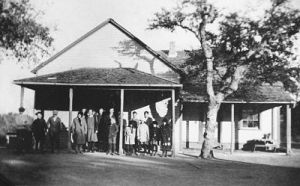
Balcones School 1930s
For most of the 20th century the school bells did not start ringing until the day after Labor Day. The last day was usually around Memorial Day. In the early part of the 1900s, school sometimes didn’t start until October and ended in March, as was the case in 1900-1901, when my grandfather, Willie Adam, was seven years old. The school year began October 15, 1900, and ended March 16, 1901. He attended the Balcones School located on the Boerne Stage Road or at that time it was the main road from Boerne to San Antonio. (Highway 9). The school building is located next to the Balcones Creek which is the boundary line between Kendall and Bexar Counties. Most residents in Kendall County call this school the Lower Balcones School.
In 1900-1901 school year, the Balcones School was a one room wooden school house with 20 double desks. During the 1908-1909 school year, Willie was the oldest boy in the school and his younger brother Eugene and his sister Hilda also attended school with him. The building had not changed from the 1901 assessment but in 1910 a new one was built. My father always understood the one room school burned down and in its place a two room school was built.
My father, his brother and many of his cousins attended the Balcones School. His grandfather, Julius Adam, was on the school board for a number of years and later his son, Willie Adam, served on the board. Sometimes during a school year, the school teacher lived with Julius and Ida Adam . It was about a mile walk to school from the Adam farm.
A couple of memories from attending school there in the 1930s.
One time, the wooden shingle roof on the Julius Adam home caught fire and someone came and got the school kids so they could form a bucket brigade. They put the fire out. Don’t you know that was exciting but hard work!
In 1936, Texas was celebrating its Centennial. The school teacher took a number of the Balcones students on the train to Dallas to experience the State Celebration and Fair. Daddy, his brother, his cousins Jack, Wallace, Julian, Doris and a number of others went. They stayed for three days. While on the train, it seems the older boys in the group (brother and cousins) convinced my father that he could fit in the luggage compartment. They assisted in squeezing him into the compartment but he got stuck and couldn’t get out! They had to call a conductor to help him. While at the fair, the kids rode the carnival rides, looked at the exhibits and had a great time. It was “lots of fun.“
What I want to know is, did the teacher have as good a time as the kids? What were all of their parents doing while practically all the kids in the neighborhood were gone? Were they dancing in the street?


My großmutter, Laura Fanny (Whitworth) and my großpapa, Walter B Voges farmed and ranched on what
is now (sniff, sniff) Regent Park housing development (by the African violet nursery). He is the son of Theresa Adam and Frederick (Fritz) Voges. My father Clyde (Speck) Voges went to school at Balcones. He was born in 1921. He only went through 8th grade. He told me he had to stop because times were so hard he was needed at home. I don’t know if this will help anyone but the B in Walter B Voges, isn’t his name. At the outbreak of WW1, there were 2 Walter Voges in Kendall county. Neither had a middle name. They were assigned A and B by the war dept. Großmutter was the daughter of Thomas Bedom Whitworth and Emma Stendebach, her father was JF Stendebach. Großmutter’s brother, Edward (Papa Ed) Whitworth married Paula who was Paula Voges the daughter of Theresa (Adam) and Frederick Voges.
Theresa Adam + Frederick Voges Emma Stendebach + Thomas Whitworth
Walter + Laura
Paula + Edward
My question is in regards to genetics. While there is nothing untoward in these marriages, the children are closer than average first cousins. Genetically, they are almost closer to being siblings than cousins. They called themselves “double first cousins”. Is that a correct term? It seems to me that these offspring would be a huge source for those studying genetics especially in determining what is passed from the mother or the father specifically.